





The idea of what it takes to develop leaders gets overcomplicated.
Here’s how I think about it:
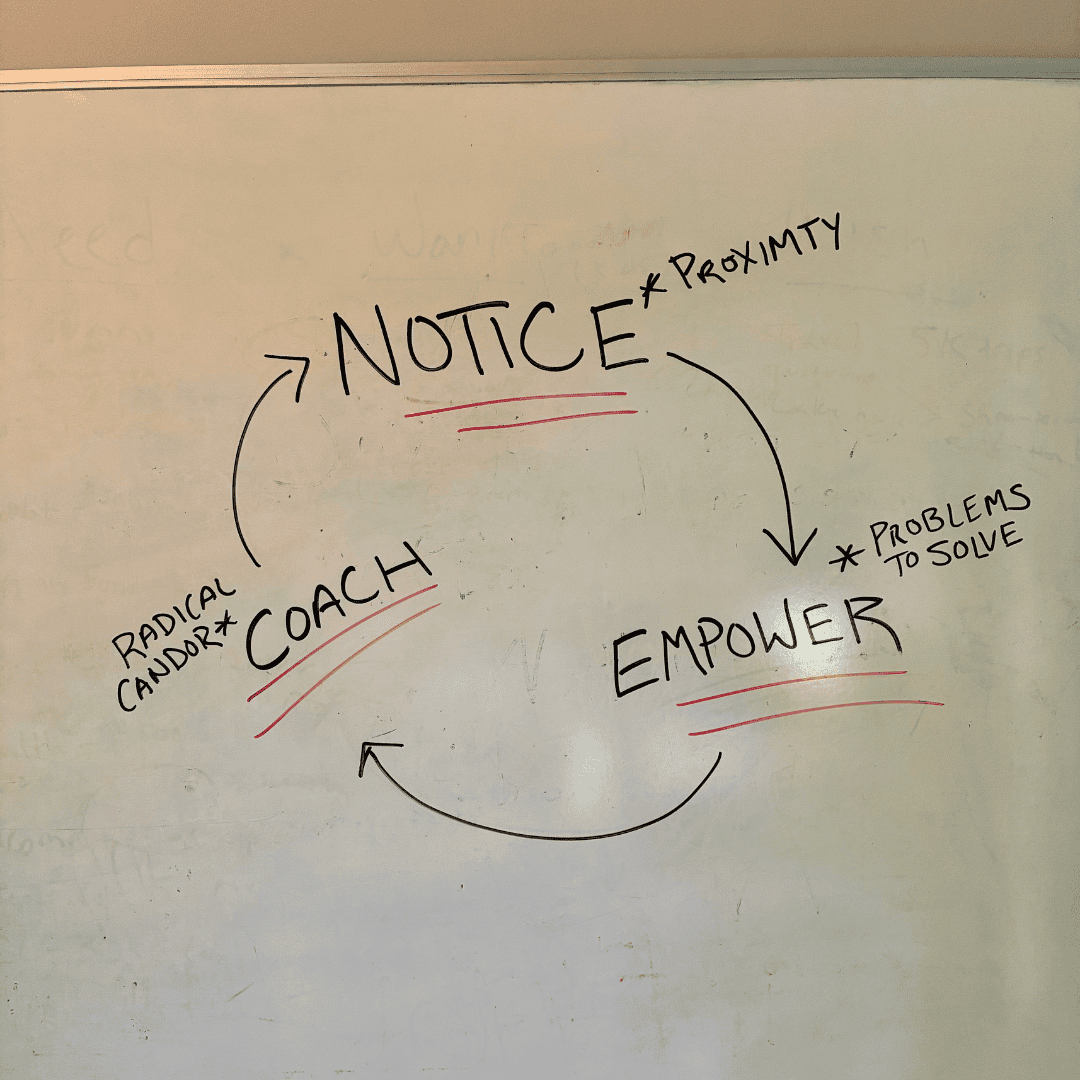
You notice leadership capacity in someone. You empower them with an opportunity to solve a problem. You coach them to their full potential.
And you’re doing that all the time.
Let me drill down a bit.
Notice
It’s doesn’t take much to notice the capacity to lead in someone, but it does require proximity. You won’t notice abilities in people you never observe.
We don’t need complex curriculum and classes and cohorts when we have leaders in leadership roles, just doing what leaders do, and the organization provides close proximity of leaders to potential leaders.
But as we grow—and, particularly when we recognize we’ve not been good at spotting capacity across diverse areas of our congregation—we sometimes need to create more intentional space for proximity. Noticing capacity across ages, genders and races is impossible unless you are spending time with people across ages, genders and races.
Empower
Don’t overthink the word. Tony Morgan used to say all the time that leaders don’t respond to need, they respond to a problem to solve. He often shared that in the context of inviting volunteers to serve as leaders at church.
This idea is equally applicable when you’re thinking about development. When you notice leadership capacity in someone, invite them into solving a problem. Be the match-maker. Empower them to run with it.
Leaders spot leadership capacity in others, and they can’t help but create opportunities to empower. (“Let’s see what you can do…”)
Coach
The coaching (feedback, support, etc.) seems to be where a lot of the emphasis in leadership development gets placed. It’s absolutely important: If you’re empowering people to solve problems, and especially if you’re asking them to level up and solve a bigger problem than they’ve solved before, you need to be available to them for feedback and support. I love Kim Scott’s “Radical Candor” definition of “challenging employees directly while caring for them personally.”
Sometimes, a person flourishes in that same role or function for a long time. Sometimes, as you coach, you quickly see even more capacity. When you do, your job as a coach is to challenge them: to invite them into another opportunity to solve a problem. That’s how you coach them to their full potential, not just to the success of the current opportunity.
This cycle is a gap in many churches, and for an understandable reason.
Put leaders in leadership roles.
Paul identifies five spiritual roles based on gifting, of which “pastor” is one, and yet in our churches we often just call everyone who is organizationally high on the chart “pastor.” (I’m not getting into the male/female theological title debate here). “Leader” is one of the five, too, and those two words do not have interchangeable meanings.
Am I saying you can’t be gifted to be both a pastor or teacher and a leader? No, not at all—many of you are. Am I saying you can’t be a pastor if you are not also gifted as a leader? … also no.
I don’t think you necessarily have to have the leadership gift to see it in another person. Any parent can guess which kids are going to take charge and solve problems just watching a game emerge on the playground.
But you do need people with that gift to create a culture where noticing capacity, looking for problems to solve that make good opportunities for leaders to level up, and coaching developing leaders to their full potential takes place all the time. To quote a common Unstuck refrain: You put leaders in leadership roles.
What’s next?
What is clear to me after 13 years on the Unstuck team is that churches often say they need more leaders, and the solution always starts with noticing who on staff has the capacity to solve the problem, empowering them to run with it, and getting them the coaching they need as they own the responsibility of making this cycle the default throughout every level of the team. (We help them do that in our Staffing and Structure Process.)
It’s also one reason we offer leadership cohorts. Speaking of which, we have a few openings in our next ones for Lead Pastors, Multisite Leaders and Campus Pastors.
Coaching won’t turn someone who is not a leader into one, but it will help someone gifted as a leader to step into their full capacity.






Leave a Reply